
Fashion should not cost the earth.
But with the Strait of Hormuz will open up, the oil will flow freely again, so why focus on Textile-2-Textile recycling?
By Josse Kunst, CuRe Techology
22nd June 2026
With all the dynamics in the world it is very clear that current world leaders have their decisions deeply rooted in a fossil-based economy. The EU is making brave attempts to regulate a circular future but the pace of new legislation kicking in is slower than the melting of the glaciers in the Alps. Therefor one may be forgiven to start thinking that we can afford to ignore textile to textile recycling. So, let’s look at some of the fundamental facts of the textile industry to see if we can ignore T2T recycling or not.
It’s big
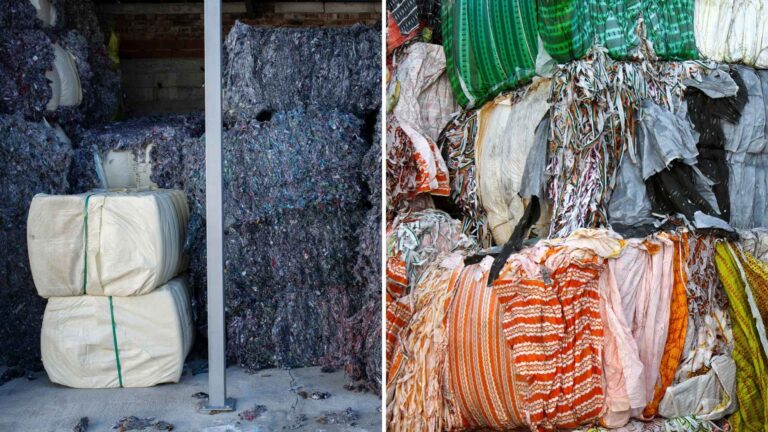
We consume too much clothing, 60% more per person than 15 years ago in fact. We create a humongous pile of waste as a result. According to the latest report of the European Environment Agency (EEA) 16 kg of textile waste is generated per person in the EU every year as of 2022. That may not sound so impressive but if you realize that there are 450 million people in the EU it means we create 7.2 billion kg of textile waste every year. That is one Olympic size swimming pool filled every 1,5 hour just in the EU alone. And all this while the textile industry creates 1.5 trillion USD turnover every year. Time to take responsibility, I’d say.
It heats up the planet.
With a supersized El Nino coming our way we are bracing ourselves for a hot summer. If we would incinerate all the EU textile waste, it generates 23.8 million metric tons of CO2eq. This is the same as 20 % of the annual carbon footprint of the Netherlands. Creating new fibers to replace them doubles this.

It creates undesired geopolitical dependence
Fossil based textile is made from oil pumped up in the US or the Middle East and manufacturing into fibers and clothing in China and other parts of Asia. As European Union we need to think carefully if we want to be so totally dependent solely on others for something we all use daily. It will be tough to get to full independence on the resources for our clothing, but we should at least move towards less dependence.
It avoids pollution
The textile industry is a very polluting industry, accounting for 8 to 10 % of the global CO2 emissions (UNEP, 2024), with 20 % of the global industrial wastewater comes from textile dyeing and treatment (Worldbank) thereby releasing heavy metals such as chromium, lead, mercury, cadmium, arsenic, copper, nickel and cobalt into waste water through 280.000 tons of dyes wasted annually. And then we have not even touched microplastics of the use of PFAs. So if we can reduce the production of new clothing by reusing or recycling, we reduce pollution. It’s as simple as that.
So, at face value it seems to me that textile to textile recycling makes a lot of sense and is not a short-term gimmick, but a long-term behavioral system change we need to implement. And that is exactly what we aim to address in project STREP. Early June a global group of textile industry players came to Amsterdam, the Netherlands for Fashion for Good’s Innovation Fest to discuss the latest innovations and collaborations to create a more sustainable textile industry. A warm bath of like-minded souls having the stamina to stay focused on this important topic. A festival of critical hope. The gist of the sessions to me is that the tech is there to do it, or we develop it in the next few years. What we need it clear mandatory legislation to get the industry out of the current waiting mode and financial support to build the required infrastructure. In that context it is worthwhile to create attention for two leading events coming up: the Textile Recycling Expo in Brussels on June 24 and June 25, as well as the Hackathon in Amsterdam on June 30 to Bridge the Funding Gap organized by the Dutch Recycling group.
Hope to see you there so we can share what Project STREP does to continue to push for a more sustainable textile industry.